Edwin Jorge · Senior Software Engineer · Mercado Libre

I build software people and agents rely on.

Edwin Jorge, smiling, in glasses and a black t-shirt

Senior engineer at Mercado Libre: five years shipping production web, native mobile and smart‑TV surfaces to millions of users across LATAM. Outside work I build AI‑agent systems in public: two live MCP servers, a GitHub triage bot, an eval CLI and a React profiler on npm. Everything here runs today.

users across the surfaces I ship
4.3M+
users across the surfaces I ship
projects written up in depth
6
projects written up in depth
years in production
5+
years in production
Barranquilla · remote
UTC−5
Barranquilla · remote
$ curl -s ask-edgeorgie-mcp.vercel.app/api/ask \
-d '{"question":"what has he shipped?"}'
{ "answerMode": "llm", "model": "claude-haiku-4-5",
"citations": ["resume.txt:49-78",
"RECRUITER-FAQ.md:23-47"] }

A real MCP server that answers questions about my work, with citations. Try it yourself in Ask me MCP, further down.

01Work

Six things you can run today.

Six case studies you can run today. All public: a repo, a live URL or an npm package. Every number traces back to a committed benchmark, a CI run or the registry. Expand a card for the problem, my role, the architecture and what was hard.

Live · public MCP server01
Tools exposed over MCP
  • 01get_experience()
  • 02get_projects()
  • 03get_story()
  • 04ask_about_edgeorgie()

Same engine as the console on this page.

Ask it here ↓

ask-edgeorgie-mcp

A résumé you can interrogate. An MCP server about me, with every answer cited to a file and line.

Status
Live
public, no auth wall
Answer mode
llm
claude-haiku-4-5, cited
Tools
4
over HTTP + stdio
Local tests
5/5
passing
TypeScriptMCP SDKTF-IDF retrievalAnthropic APIVercel
Case study: problem, role, architecture, challenges

Problem

A résumé can't answer follow-up questions, and an AI recruiter can't read a PDF. This lets a person or an agent ask directly and get grounded, cited answers without me in the loop.

Role

Solo: retrieval design, server, prompt guardrails, deployment and verification.

Architecture & decisions

  • Official @modelcontextprotocol/sdk over Streamable HTTP and stdio; four tools: get_experience, get_projects, get_story, ask_about_edgeorgie.
  • TF-IDF retrieval from @edgeorgie/retrieval-core (shared with repoask-mcp) over four committed public files: resume, reliability report, build log, recruiter FAQ.
  • Grounded synthesis with claude-haiku-4-5 when a key is configured; deterministic cited-excerpt mode otherwise. Same corpus, same citations either way.
  • Scoped to questions about me: declines off-topic requests and resists prompt injection from its own retrieved text.

Engineering challenges

  • Every claim in a generated answer must map back to a source excerpt with a line range, or the answer is not emitted.
  • Verified by a real external MCP client over HTTP against the deployed URL, not a local stdio demo.
Live · web app02
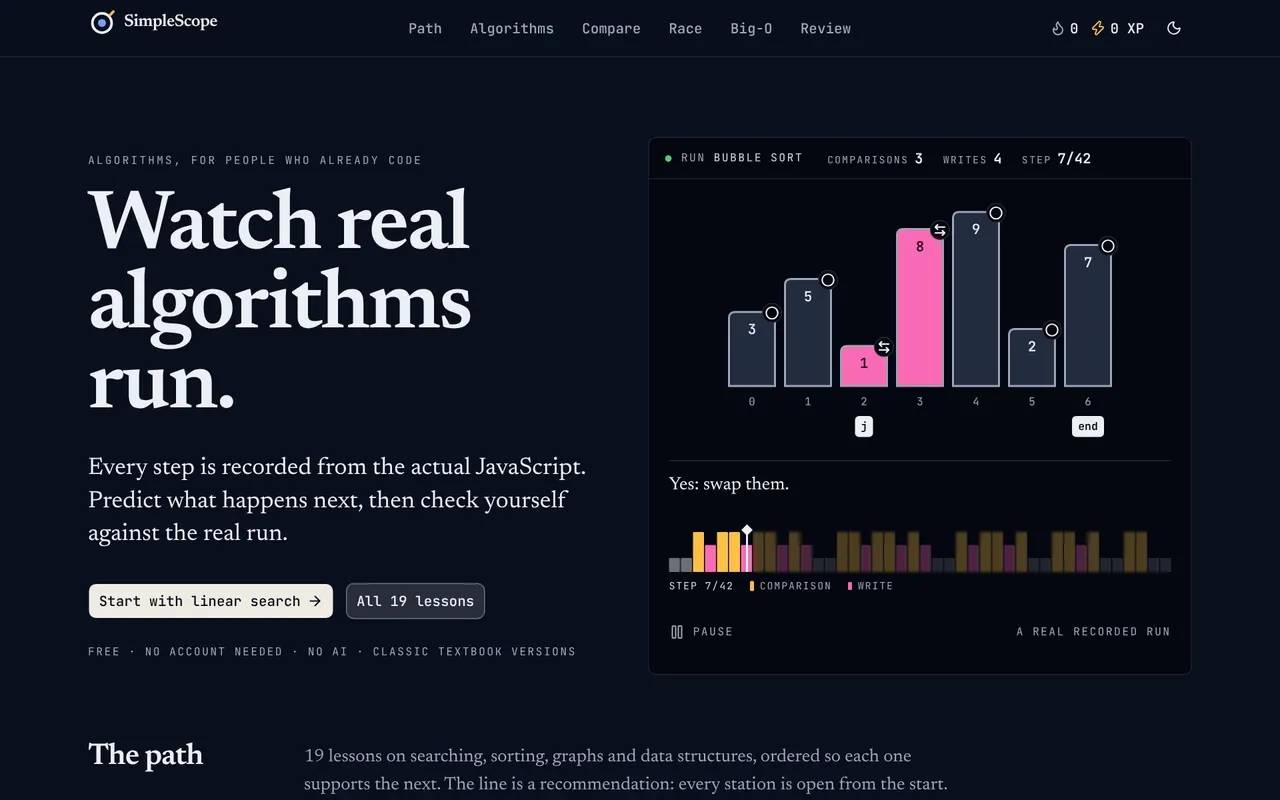
SimpleScope landing page: a bubble-sort run visualised as bars, with step 6 of 42, comparisons and writes counted live.

simplescope

Learn algorithms by watching real JavaScript run, step by step, and predicting what happens next.

Status
Live
publicly deployed
Lessons
19
searching, sorting, graphs, DS
Required env vars
0
works out of the box
Stack
Next.js
App Router + TypeScript
TypeScriptNext.jsTailwind v4shadcn/uiMDX
Case study: problem, role, architecture, challenges

Problem

Algorithm courses show static diagrams or pseudo-code. SimpleScope records every step from the actual running JavaScript so you can scrub through a real execution, predict the next state, and check yourself.

Role

Solo: product, interaction design, visualiser engine, lessons, deployment.

Architecture & decisions

  • Next.js App Router + TypeScript + Tailwind v4, lessons authored in MDX, UI primitives from shadcn/ui.
  • An instrumented runner records comparisons and writes from the real algorithm implementation; the visualiser replays the trace.
  • Zero required environment variables: progress lives in localStorage, with optional account sync when configured.
  • Learning loop with XP, streaks, race and compare modes across 19 lessons.

Engineering challenges

  • Making the recorded trace both faithful to the code and legible at a glance (highlighting the current comparison, write and pointer).
Published on npm03
one engine · four surfaces
render profiler
  • CLIcrispy scan · run · test · compare
  • GitHub Actionfails PRs on re-render regressions
  • MCP serverscan_app · test_render_snapshots
  • Agent Skillmeasure → fix → re-measure

validated on 5 real OSS apps

crispy-profiling

A React re-render profiler for humans and agents: measure the fix instead of guessing at it.

npm
v0.6.0
7 versions published
Validated on
5
real open-source apps
Surfaces
4
CLI · Action · MCP · Skill
React
19
tested; 18.3 / 19.0 validated
TypeScriptPlaywright / ChromiumMCP SDKGitHub Actionsnpm
Case study: problem, role, architecture, challenges

Problem

Unnecessary re-renders are easy to suspect and hard to prove. crispy-profiling opens the app in headless Chromium, drives the interactions you describe, and reports which components rendered, how often and why.

Role

Solo: profiler engine, four product surfaces, validation against real apps, npm release.

Architecture & decisions

  • One engine, four surfaces: CLI (crispy scan / run / test / compare), a GitHub Action that posts to the job summary and PR, an MCP server (scan_app, test_render_snapshots) and an Agent Skill for Claude Code, Cursor and Codex.
  • Attributes each render to props, state, context or parent, and snapshot-tests re-render counts so regressions fail CI.
  • Needs no changes to the target app; CI matrix on Node 20, 22 and 24.

Engineering challenges

  • Validated against five real open-source apps (Redux Essentials, Next.js App Router Playground, Excalidraw, shadcn-admin, react-admin), finding a fixable re-render problem in each.
Shipped · autonomous bot04
issues: opened → labels

webhook · issues: opened

Bug: duplicate detection crashes on empty issue body

Opening an issue with no body text throws inside the dedup step before labels get applied.

↳ classified:bugp0confidence 40%
real run · issue #24 ↗

triage-desk

A GitHub bot that triages new issues on its own, triggered by the real webhook, not a button.

Real webhook run
22 s
success, triggered by issues
Kind accuracy
83.3%
15 / 18 benchmark
Priority accuracy
83.3%
15 / 18 benchmark
Local tests
22/22
passing
TypeScriptGitHub ActionsOctokitNode.js
Case study: problem, role, architecture, challenges

Problem

Issue triage is repetitive and delayed. The bot reads a new issue the moment it opens, classifies kind and priority, flags likely duplicates, posts a comment and applies labels.

Role

Solo: agent design, tools, benchmark, GitHub Actions workflow.

Architecture & decisions

  • Runs from GitHub's own issues: opened webhook through a GitHub Actions workflow; a headless script reuses the agent, tools and triage schema.
  • Falls back to a deterministic heuristic when no LLM key is configured, so the pipeline produces real, non-fabricated output end to end either way.
  • JSON run logs uploaded as workflow artifacts; its own CI is gated by eval-lab.

Engineering challenges

  • Accuracy is measured against a committed 18-issue benchmark rather than eyeballed: 15/18 on kind and 15/18 on priority.
Shipped · CLI + GitHub Action05
24/24 cells passing100%

point-in-time result from the linked CI run

benchmark run · 3 passes ↗

eval-lab

An installable CLI and GitHub Action that fails CI when a prompt regresses.

Benchmark
24/24
cells passing, 3 runs
Avg latency
~20 ms
per cell
Local tests
7/7
passing
Benchmark cost
$0
offline demo model
Node.js ESMGitHub ActionsCLI
Case study: problem, role, architecture, challenges

Problem

Prompt changes break things silently. eval-lab runs prompt variants against test cases with deterministic checks and an LLM judge, then diffs runs so a regression blocks the merge.

Role

Solo: runner, judge, Action packaging, dogfooding on two repos.

Architecture & decisions

  • Variant runner + deterministic checks + LLM judge + regression diff, packaged as a CLI (npx eval-lab run) and a reusable composite GitHub Action.
  • Dogfooded on its own CI and on triage-desk's CI: it ran triage-desk's real heuristic-triage function and gated a real PR on the result.

Engineering challenges

  • Keeping the benchmark free: an offline demo model gives a $0, deterministic baseline for CI.
Live · public MCP server06
Tools exposed over MCP
  • 01index_repo()
  • 02ask_repo()
  • 03list_indexed_repos()

Citations come back as file:line ranges.

Open the live UI ↗

repoask-mcp

Ask any public GitHub repo a question and get line-cited answers, over MCP or a web UI.

Status
Live
public, no auth wall
Tests
42
across 9 files
Tools
3
index · ask · list
Transport
HTTP
+ stdio
TypeScriptMCP SDKExpressZodVercel
Case study: problem, role, architecture, challenges

Problem

Reading an unfamiliar codebase is slow. repoask-mcp indexes a repo's text files and answers questions with file-and-line citations, usable by any MCP client or from the browser.

Role

Solo: indexer, MCP server, REST wrappers, web UI, deployment.

Architecture & decisions

  • index_repo / ask_repo / list_indexed_repos on the official @modelcontextprotocol/sdk, over Streamable HTTP (/mcp) and stdio.
  • TF-IDF chunk index built from the GitHub REST API; Zod-validated tool schemas; optional LLM synthesis with claude-haiku-4-5 or gpt-4o-mini.
  • The human UI calls the same TypeScript functions the MCP tool handlers call: one engine, two front doors.

Engineering challenges

  • Verified from a real external MCP client over the open internet, with real citations back.

More projects

9 more, for humans and agents.

The public, non-fork repos that aren’t a case study above — MCP servers, CLIs, evals and web apps, each with a repo, a live URL or an npm package.

See all 9

02Skills

Capabilities, with receipts.

No self-rated bars. A filled dot means I’ve used it in production at Mercado Libre; a project name means the code is on this page.

Character sheet

Edwin Jorge

class
Full-stack engineer
spec
AI agents · cross-platform UI
level
5+ yrs in production
base
Barranquilla, Colombia · UTC−5
status
Open to remote roles · relocation with sponsorship
langs
TypeScript · JS · Kotlin · Swift · Python

Unlocked · achievements

  • 1.5M+ users, zero incidents

    One production feature at Mercado Libre, delivered in record time.

    source: resume ↗
  • 10+ initiatives owned end-to-end

    Solo ownership from scope to delivery; together reaching 4M+ users across LATAM.

    source: resume ↗
  • Shipped to living rooms

    Smart TV receivers for LG, Samsung Tizen, Vidaa, TitanOS and a Chromecast Web Receiver.

    source: resume ↗
  • Published to npm

    crispy-profiling v0.6.0, seven releases, MIT.

    source: npm ↗
  • Two public MCP servers live

    ask-edgeorgie-mcp and repoask-mcp, reachable by any MCP client over HTTP.

    source: endpoint ↗
  • A bot that works from the real webhook

    triage-desk triaged issue #24 in 22 s, triggered by issues: opened.

    source: run ↗
  • First game shipped at 15

    A 2D platformer, built and released solo. About 50 downloads.

    source: FAQ ↗
  • Two degrees

    Electronic Engineering and Software Development.

    source: resume ↗
  • Led teams, spoke at events

    Two MERN teams at UdeA; IEEE talks with 50+ and 100+ attendees.

    source: resume ↗

Frontend engineering

Where I'm deepest: TypeScript and React, from component architecture to render performance.

  • TypeScript (used in production)
  • React (used in production)
  • Next.js (used in production)
  • Component architecture & design systems (used in production)
  • Accessibility (used in production)
  • Render performance (used in production)
  • Tailwind CSS
  • Framer Motion (used in production)

seen in: ask-edgeorgie-mcp · repoask-mcp · crispy-profiling · simplescope · triage-desk

AI & agent engineering

Agents as production systems: tools, retrieval, evals and guardrails, not just prompts.

  • MCP servers
  • Agent workflows & orchestration (used in production)
  • LLM integration (Anthropic, OpenAI, local) (used in production)
  • Retrieval / RAG
  • Evals & LLM-as-judge
  • Prompt injection guardrails
  • Agent skills (Claude Code, Cursor, Codex) (used in production)

seen in: ask-edgeorgie-mcp · repoask-mcp · crispy-profiling · triage-desk · eval-lab

Backend & APIs

APIs that stay fast under load: caching, idempotency, low-latency design.

  • Node.js (used in production)
  • Express (used in production)
  • REST design (caching, idempotency) (used in production)
  • GitHub API / webhooks / Octokit
  • Python (used in production)
  • MongoDB · MySQL · SQLite (used in production)

seen in: ask-edgeorgie-mcp · repoask-mcp · eval-lab · triage-desk

Platforms beyond the browser

The same product shipped to phones and living rooms.

  • Mobile WebViews (used in production)
  • Android (Kotlin), AI-assisted (used in production)
  • iOS (Swift), AI-assisted (used in production)
  • Smart TV: LG webOS, Samsung Tizen, Vidaa, TitanOS (used in production)
  • Chromecast Web Receiver (used in production)

Reliability & architecture

Observability and structure that survive the refactor.

  • Kibana · New Relic · Datadog · Grafana (used in production)
  • SLA / SLI / SLO practice (used in production)
  • Clean Architecture & DDD (used in production)
  • Legacy refactoring (used in production)

Testing & delivery

If it isn't verified, it isn't done.

  • Unit · integration · E2E (used in production)
  • Jest · Cypress (used in production)
  • Vitest · Playwright
  • GitHub Actions / CI gates
  • Vercel deployments

seen in: repoask-mcp · triage-desk · crispy-profiling · eval-lab · ask-edgeorgie-mcp · simplescope

03Experience

Production engineering at LATAM scale.

Taken from my résumé, nothing added. Each bullet is work I owned end to end.

  1. Mercado Libre

    Senior Software Engineer

    Nov 2022 — Present

    Remote

    LATAM's largest e-commerce platform, 4.3M+ users on the surfaces I work on. Full-stack across web, native Android/iOS and smart TV/OTT, with observability and clean architecture as standing responsibilities.

    • Owned 10+ initiatives end-to-end solo, together reaching 4M+ users across LATAM; one feature alone served 1.5M+ users with zero production incidents.
    • Led cross-platform work spanning web, mobile WebViews and AI-assisted native development in Kotlin (Android) and Swift (iOS), using Spec-Driven Development and a scalable frontend architecture.
    • Shipped smart TV and OTT surfaces for video streaming: web receivers for LG, Samsung (Tizen), Vidaa and TitanOS, and a Chromecast Web Receiver.
    • Built backend APIs with caching, idempotency and low-latency design underpinning the same web, mobile and TV surfaces.
    • Implemented observability with Kibana, New Relic, Datadog and Grafana aligned with SRE practice (SLA / SLI / SLO).
    • Applied Clean Architecture and Domain-Driven Design while refactoring legacy systems; comprehensive unit, integration and E2E testing.
    • Designed and owned AI-agent architectures end-to-end (agent rules, skills, cross-service orchestration) as a sustained production responsibility, not a one-off project.
  2. Vansa

    Front-end Developer

    Feb 2022 — Jul 2022

    Remote

    React applications and responsive dashboards with JavaScript, SASS and Framer Motion; performance, accessibility and cross-browser work; Atomic Design, SOLID and Clean Architecture for reusable components.

  3. Freelance

    Front-end Developer & UI/UX Designer

    Apr 2020 — Feb 2022

    Remote

    Designed frontend architectures and design systems; translated Figma designs into scalable React interfaces with reusable components and hooks; improved Time to Interactive with Next.js SSR and SEO work.

Leadership

Before Mercado Libre

  • University of Antioquia

    Head of development and design · Jul — Dec 2021

    Led two MERN development teams; roadmaps in Figma and Trello; sprint planning with Scrum.

  • IEEE student branch, Barranquilla

    Lead and board member · 2019

    Coordinated and spoke at two online events: a Python workshop (50+ attendees) and an IoT application-architecture talk (100+).

04How I use AI

AI, run like production.

Not a chat window. One pipeline every piece of work goes through: an always-on operator that only wakes the expensive run when something actually changed, builder agents working in parallel behind a guard and a shared audit trail, and a cold-context critic plus artifact verification before anything is called done.

Three lanes. Operator, always on: a cron tick runs a cheap deterministic change check; nothing changed goes to a quiet log, a change wakes a build run, and only failures escalate to a real alert. Build, in parallel bursts: a brief with acceptance criteria is decomposed into independent pieces, routed to a model by stakes, given standing skills, passed through a pre-execution guard, run by several isolated agents concurrently, and every result lands in one audit-trail log with its evidence. Verify, before anything is called done: a cold-context critic reviews the work, the artifact itself is verified against the live URL, test run or log line; a fail loops back to the agents, a pass ships through secret scanning and CI. Each node is a button that reveals the rule behind it. Six of my own projects are attached to the step they were built for: triage-desk at the wake step, budget-keeper at routing by stakes, repoask-mcp at the agents, agentlens at the audit trail, eval-lab and crispy-profiling at artifact verification; they are listed with links under the diagram.

one piece of work, end to end · tap any node

0 of 16 nodes explored

01 · Operator

always-on · Hermes on cron

no
yes

wakes a build run only when something actually changed

02 · Build

parallel bursts · Claude Code

every result lands in one audit trail with its evidence

03 · Verify

before anything is called done

fail
pass

fail loops back to the agents; pass ships

In the loop

Six of the projects on this page were built for a step of this pipeline, and that is where they get used. Each one is marked on its node above.

  • triage-deskoperator · wake a build runThe same wake pattern on a webhook: a new GitHub issue wakes the bot, nothing else does.case study →
  • budget-keeperbuild · route by stakesA hard per-run USD budget enforced at the token level, automatic model-tier routing and a kill-switch with partial-result handoff.repo →
  • repoask-mcpbuild · agents × NLine-cited answers about any public repo over MCP, so an agent reads the code instead of guessing at it.case study →
  • agentlensbuild · audit-trail logA waterfall of every tool call an agent made: latency, tokens, cost, nesting, errors.live →
  • eval-labverify · verify the artifactFails CI when a prompt regresses, as a CLI and a GitHub Action.case study →
  • crispy-profilingverify · verify the artifactMeasures React re-renders before and after a fix instead of taking the fix on faith.case study →

Operating rules

The nine rules the pipeline encodes. Each one exists because something went wrong without it.

05Ask me MCP

Don’t take my word for it. Ask.

This terminal talks to ask-edgeorgie-mcp, a public MCP server I built about my own work. Answers come from my résumé, reliability report, build log and recruiter FAQ, cited by file and line. Slash commands run locally and never leave the page.

Ask a question to see the live answerMode: generated prose if a model key is active upstream, or a direct cited excerpt otherwise.

ask-edgeorgie-mcp · streamable-http · /help for commandslive

Ask anything a recruiter would, e.g. “What has this person built with AI agents?” Or type .

Point your own agent at it

{
  "mcpServers": {
    "ask-edgeorgie": {
      "url": "https://ask-edgeorgie-mcp.vercel.app/mcp"
    }
  }
}

Paste into Claude Desktop or Cursor to get get_experience · get_projects · get_story · ask_about_edgeorgie as tools. Open the standalone endpoint ↗

06Beyond the code

The same habit, from age 15 to now.

Build it yourself to understand it, whatever “it” is. Six real beats, in order, from the same FAQ the MCP server reads.

07Contact

Let’s build something people rely on.

Open to remote roles, and to relocating with sponsorship. Everything above links to a real repo, run or deployment, and I'm happy to walk through any of it on a call.